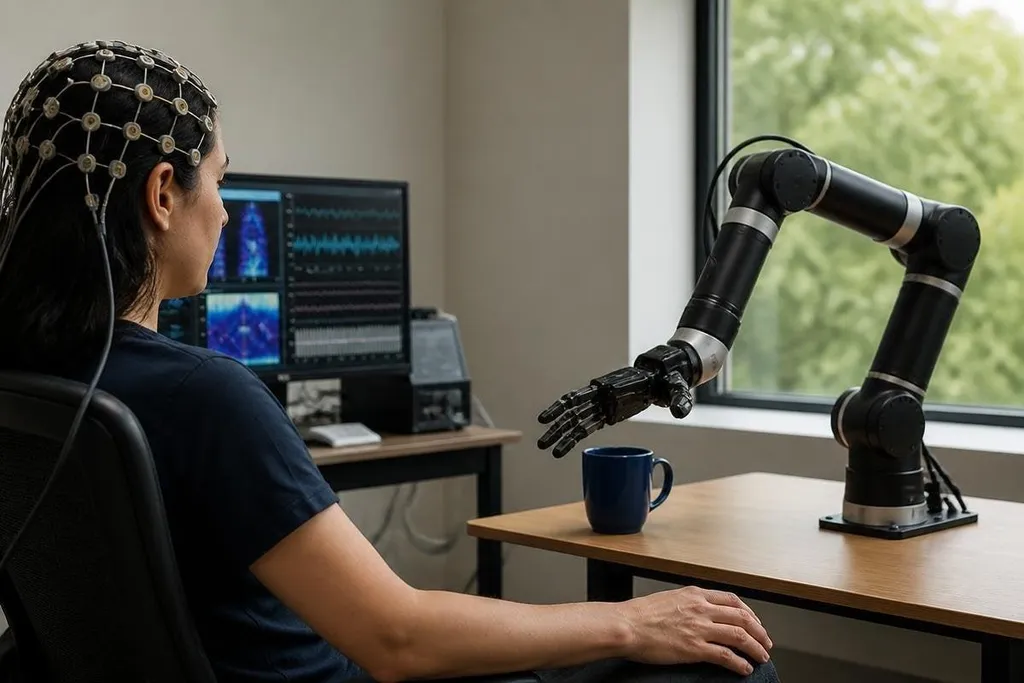
A brain-controlled robotic arm can open a hand, move toward an object, or hold a cup after software reads patterns of brain activity. The hard part is building a reliable link between an intended action, a computer decoder, and the arm’s motors.
- Brain activity reaches the computer through implanted electrodes or sensors on the scalp.
- Decoder software turns changing signal patterns into movement commands.
- Feedback helps the person correct the arm when its first movement is off target.
Where the control signal comes from
The brain does not send a ready-made command such as “move the elbow 10 degrees.” Groups of nerve cells change their activity as a person plans and attempts a movement. A brain-computer interface, or BCI, measures part of that activity and looks for patterns linked to actions.
Implanted systems place electrodes near the areas that control movement. They can pick up clearer signals from individual brain regions, though surgery brings risks and the hardware must stay reliable inside the body. Non-invasive systems, such as electroencephalography, use sensors on the scalp. They avoid surgery, but the signals pass through skin and bone before reaching the sensors.
The choice affects control. A clearer signal can support more detailed movement, while a weaker signal may limit the arm to broad commands such as left, right, open, or close. The person may also need training so the decoder learns which signal patterns match each intended action.
How software turns signals into movement
The computer first cleans the incoming data. It removes some electrical noise, checks the signal quality, and looks for changes that match the user’s trained patterns. A decoder then estimates the intended command and sends it to the robotic arm’s controller.
That command may control a joint angle, hand opening, or movement direction. The arm’s controller turns the command into motor motion while checking limits such as joint position and speed. A delay between thought and movement is called latency. Even a short delay can make an arm feel slow or difficult to guide.
The decoder usually improves through repeated use. Each session gives the software more examples of the person’s signals, while the person learns how to produce patterns the system can separate. This shared calibration takes time, and signal changes from fatigue, electrode movement, or muscle activity can affect the result.
Why feedback matters
A one-way command channel leaves the person guessing. If the arm moves toward a cup, the user needs some sense of position, contact, and grip force to correct the next command.
Feedback can come through sight and sound. Some systems also test electrical stimulation or other methods that give the user a sense of touch or movement. The signal may tell the person that the fingers touched an object, though recreating natural sensation remains difficult.
A delay in the decoder or feedback signal can make a user’s command arrive late or feel wrong. So the arm, decoder, and feedback method must work as one control loop. Robot24 places brain-controlled arms beside related work on sensing, control software, and autonomy, which helps show where this approach fits before the limits become clear.
Where the technology still struggles
Signal quality can change during a session. A person may become tired, sensors may shift, and the decoder may confuse two similar movement patterns. The arm also needs safe limits because an incorrect command can move a heavy object or strike nearby equipment.
Most demonstrations use controlled tasks. A real home or workshop adds uneven surfaces, clutter, changing light, tight spaces, and objects with different weights. Those conditions test the full setup, including the sensors, software, arm, power supply, and safety controls.
Cost and access matter too. An implanted BCI may require surgery and long-term medical care. A non-invasive system may be easier to fit, yet it can offer less precise control. The right choice depends on the person’s movement needs, health, training time, and access to technical support.
Check a system before trusting a demo
Use these questions when you assess a research result or a commercial product:
- Identify the signal source: Find out whether the system uses implanted electrodes, scalp sensors, or another method.
- Check the task: See whether the arm moved freely or followed a fixed path in a controlled setup.
- Ask about training: Look for the time needed to calibrate the decoder and repeat the task.
- Look for feedback: Check how the person knows the arm’s position, contact, or grip force.
- Read the safety limits: Confirm how the system handles bad commands, signal loss, and unexpected movement.
Brain-controlled robotic arms already show that neural signals can guide machines through selected tasks. The open question is how well that control holds up across long sessions, unfamiliar objects, and daily use. Until those tests become routine, treat a smooth demonstration as a working experiment rather than proof of a finished arm.